

Exterior Painting Tips
Limewash or Regular Paint? Here’s What We Tell Our Customers
April 14, 2026
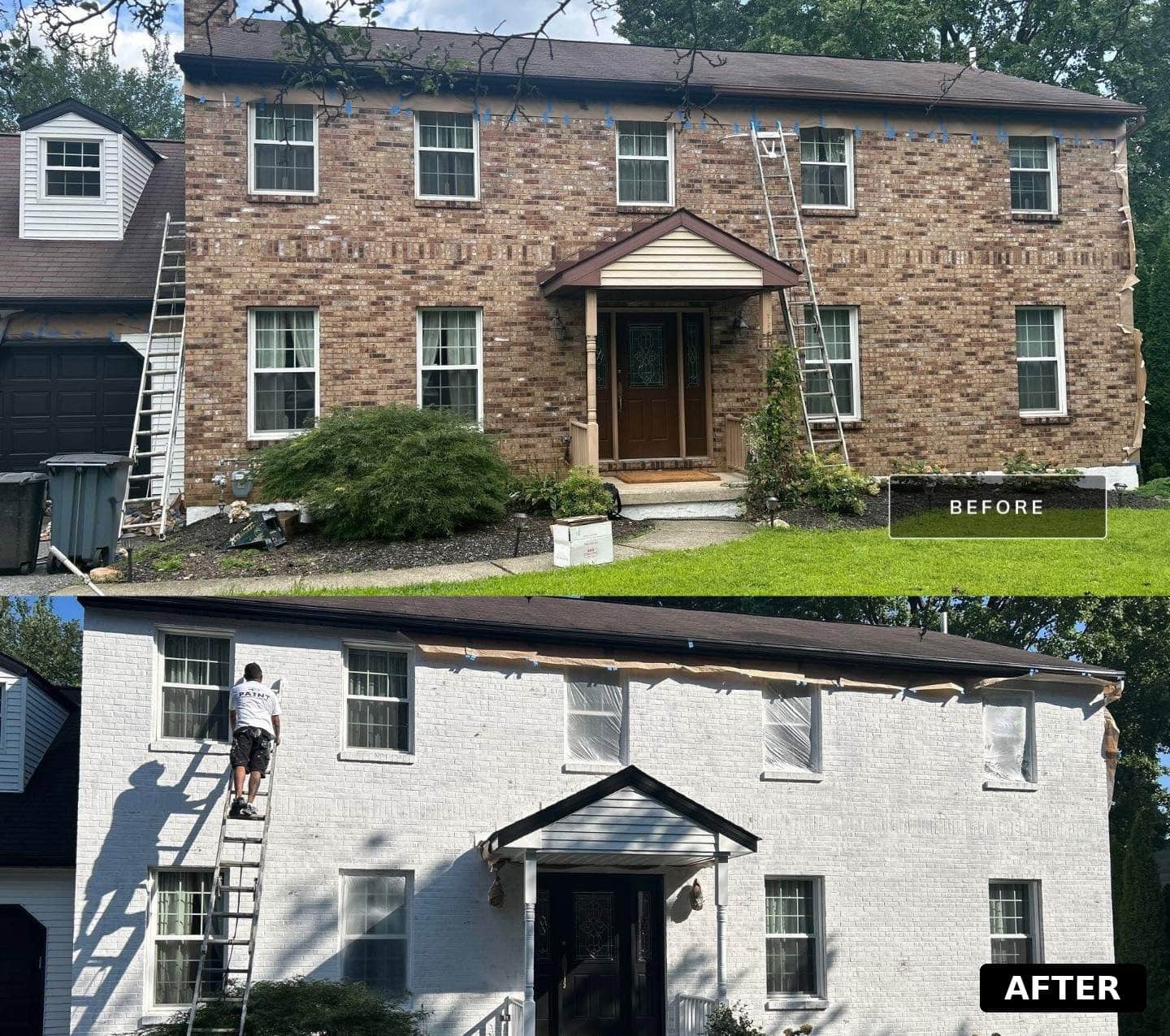
We’ve been getting a lot of questions about limewash lately. And we get it — you’ve probably seen it all over Instagram and Pinterest this year. That soft, chalky, old-world finish looks incredible in photos. But is it actually the right choice for your home?
As a painting company that does both limewash and regular paint jobs across Philadelphia, we figured it was time to lay out the differences in plain English. Just what we’d actually tell you if you called us up and asked.
So What Even Is Limewash?
Limewash is one of the oldest paints out there. It’s basically limestone that’s been crushed, burned, and mixed with water until you get a putty. You thin that putty out and brush it onto a surface, usually brick, stone, or plaster.
Unlike regular paint that sits on top of a surface like a shell, limewash actually soaks into it. That’s what gives it that look. You end up with a matte, almost see-through finish where the color shifts a little depending on how the light hits it. It looks like it’s been there for a hundred years, even on day one.
Regular paint, the latex or acrylic stuff most homes are painted with, works completely differently. It creates a solid coating on whatever surface you apply it to. Same color everywhere, smooth finish, and way more color options.
Both have their place. The right one depends on your home, your style, and honestly, your patience level.
The Look: This Is Where Limewash Wins Hearts
Let’s start with the reason most people are interested in the first place — the look.
Limewash just has a feel to it that regular paint can’t pull off. The finish has this soft texture and variation that makes a wall look more like natural stone than something out of a new construction flip. If you’ve been paying attention to what people are doing with their homes lately, you’ve probably noticed earth tones and textured walls are having a moment. Limewash fits right into that.
Regular paint gives you a clean, uniform look. If you want a crisp white wall or a bold accent color, regular paint is going to deliver that more reliably. You pick a color on the swatch, and that’s what you get on your wall.
With limewash, the color comes out softer and less uniform. It’s going to look a little different on every wall and in every room depending on how it catches the light. Some people love that. Others call us back asking if something went wrong. (It didn’t. That’s just how limewash works.)
Here in Philly, we see a lot of homeowners using limewash on their exterior brick — especially on rowhomes. It brightens up the brick without covering it completely, and it gives each house some individuality on a block where every home shares the same bones.
Durability: Here’s Where It Gets Interesting
This is where the conversation usually shifts.
Limewash on exterior brick can last a long time. We’re talking 15 to 20 years in a lot of cases. It doesn’t peel or flake the way regular paint does because it’s bonded into the surface, not sitting on top of it. As it ages, it just slowly fades, which a lot of homeowners actually prefer. You can touch it up without stripping anything down.
Regular exterior paint typically needs to be redone every 7 to 10 years, depending on the surface, the paint quality, and how much sun and weather it takes. And when it starts failing, you’re dealing with peeling, cracking, and a full prep job before you can repaint.
On interior walls though, limewash is not as tough. It scuffs easily. It’s not scrub-resistant. If you have kids running their hands along the hallway or a dog that rubs up against the walls, you’re going to see that wear way faster than you would with regular paint. You can’t really spot-clean it either without leaving a mark.
For interiors, regular paint with a satin or eggshell finish is much more practical for everyday living. We usually recommend saving limewash for feature walls, living rooms, or spaces that don’t get a ton of traffic.
Cost: Let’s Talk Numbers
Limewash jobs typically cost more than regular paint. The material itself isn’t that much more expensive, but the labor is. Limewash application takes more skill. It needs to go on in thin layers, it dries fast, and you’re usually doing multiple coats to build up the finish. Not every painter has experience with it, and you can tell when someone’s winging it.
For a full exterior limewash on a typical Philadelphia rowhome, you’re probably looking at a higher price point than a standard exterior paint job. The exact numbers depend on the size of the home, the condition of the brick, and how many coats you need.
Regular paint is way more straightforward. Faster to apply, easier to estimate a timeline, and frankly, more painters can do it well.
That said, when you factor in longevity, the math gets closer. If limewash lasts 15+ years and paint needs to be redone in 7 to 10, you might come out ahead with limewash over the long run.
What About Your Philadelphia Brick?
This is a big one for our area. Philadelphia is a brick city. Rowhomes, twins, older colonials — there’s no shortage of masonry around here.
The big thing with brick is breathability. Brick needs to release moisture. When you seal it up with regular latex paint, that moisture gets trapped, and over time it causes spalling. That’s when the face of the brick starts flaking off in chunks. We see it all the time on older homes around here, and Philadelphia’s humidity (regularly above 60%) makes it worse.
Limewash lets the brick breathe. Moisture passes through it instead of getting trapped, which means your walls stay healthier for longer. If you’ve got an older brick home in Philly, that matters a lot.
The other thing people don’t realize is that lime is naturally antibacterial. The high pH keeps mold and mildew from taking hold, which is a real bonus when you live somewhere as humid as Philadelphia.
If your brick is already painted, though, limewash isn’t going to work. It needs to soak into a porous surface. You’d need to strip the old paint first, which adds a lot of cost and labor. In that case, repainting with a high-quality masonry paint is usually the more practical move. If you’re drawn to the lighter, washed-out look but your brick is already painted, a whitewash treatment might be worth a look instead.
The Disadvantages Nobody Talks About on Pinterest
Look, we do limewash work and we like it, but we’re not going to pretend it’s perfect. There are some real downsides.
Limited colors. Limewash works best with earthy, muted tones — whites, creams, soft grays, warm tans. If you want navy blue or forest green, limewash is not your product. Regular paint gives you literally thousands of color options.
Tricky application. Limewash is finicky about temperature and humidity when you’re putting it on. If it’s too hot out, it dries before it bonds. Too cold and it won’t cure. In Philadelphia, you’re really looking at April through October for exterior limewash work.
Not great on all surfaces. Limewash needs a porous surface — brick, stone, lime plaster, or bare concrete. It doesn’t stick to drywall, wood, vinyl, or previously painted surfaces without special prep. Regular paint works on just about anything.
Hard to repair. If you nick or damage a limewashed wall, you can’t just touch up that one spot. The new layer won’t match the aged patina of the surrounding area. You’ll usually need to redo the whole wall or section.
So Which Should You Choose?
Here’s how we usually frame it for our customers:
Limewash makes sense if you have exposed brick (especially exterior), you love the textured old-world aesthetic, you’re thinking long-term, and you’re okay with a natural look that evolves over time.
Regular paint makes sense if you want a specific color, you need something durable for high-traffic areas, you’re working with drywall or wood surfaces, or you’re on a tighter budget upfront.
And honestly? A lot of our jobs end up using both. Limewash on the exterior brick, regular paint inside. Works great.
We Do Both — And We’ll Tell You Which One Your Home Actually Needs
At PAINT Philadelphia, we’ve been doing limewash and regular painting work across the city for years. We’ve seen what works on Fishtown rowhomes, what holds up on Main Line stone, and what looks incredible on the older brick in South Philly and Manayunk.
If you’re thinking about limewash, or really any kind of paint job, give us a call or request a free estimate. We’ll come take a look at your place and tell you what we’d actually do if it were our house.
Ready to see what limewash could look like on your home? Request a free estimate or call us today at (267) 229-4333.
Related: Limewashing Services in Philadelphia | Whitewashing Services in Philadelphia
Still weighing limewash against regular paint? Talk it through with our painters in Philadelphia, PA.
Want to see limewash on real homes nearby? Browse our limewash and whitewash work in Wynnewood, our limewashing in Chestnut Hill, or our limewash painting in New Hope.

Andrew Tomasetti is not just a painting contractor, he is the owner of Paint Philadelphia; a painting company in the greater Philadelphia area that services the Holland, Newtown, Churchville, Yardley, Richboro areas.
Andrew Tomasetti is both a veteran and an engineer. His passion for hands-on work comes from his father and uncle and runs deep in his veins.

Ready to get started?
Let’s get your project painted.
Schedule a free in-home consultation or call us at (267) 229-4333.